Industrial equipment developers often face a fundamental architecture decision: should they use a powerful industrial PC workstation or integrate computing directly into the equipment through an embedded platform?
Both approaches can support demanding industrial workloads, but they serve different design priorities. A workstation-style system typically focuses on higher computing resources and flexible expansion, while embedded computers emphasize integration, reliability, and deployment efficiency.
The right choice depends on how the system will operate. A laboratory analysis station, factory inspection workstation, and autonomous vehicle controller may all require industrial computing, but their hardware priorities are significantly different.
The Choice Between Workstation Computing and Embedded Design Starts With the Application
Industrial computing decisions usually begin with the equipment’s role rather than the processor specification alone. Engineers need to consider where the computer will operate, what data it must process, and how it will interact with surrounding systems.
Industrial PC workstations are often selected for applications where users interact directly with the system or where large computing resources are required in a fixed location. Examples include engineering stations, production analysis platforms, and advanced inspection systems.
Embedded computers are designed for situations where computing becomes part of the machine itself. These systems are integrated into equipment such as robots, vehicles, kiosks, industrial controllers, and intelligent devices.
The difference is not simply performance versus compactness. It is a question of computing architecture. Workstations provide a general-purpose computing environment, while embedded platforms are designed around a specific operational purpose.
Industrial PC Workstations Target High-Performance Fixed Computing Tasks
Industrial PC workstations are commonly used when applications require powerful processors, large storage capacity, multiple expansion options, or advanced graphics capabilities.
Manufacturing environments may use workstation systems for centralized machine vision analysis, production engineering, simulation, or quality management. These applications often involve complex software environments and require significant computing resources.
A workstation approach can also be beneficial when operators need a full computing interface. Engineers, technicians, and analysts may require large displays, desktop peripherals, and software tools that are easier to support on a traditional PC architecture.
However, fixed workstation designs may not always fit equipment that must operate in constrained spaces or mobile environments. Systems installed directly inside machines must consider factors such as vibration, power variation, thermal conditions, and long-term unattended operation.
Embedded Computers Bring Computing Directly Into Equipment Designs
Embedded computers address the growing demand for intelligent machines that can process information at the point of operation. Instead of placing computing resources in a separate cabinet or workstation area, embedded platforms become part of the equipment architecture.
An embedded computer can manage communication, data processing, control functions, and AI workloads within a single integrated system. This makes it suitable for applications where response time and physical integration are critical.
Industrial automation, robotics, and smart transportation systems increasingly rely on embedded computing because these applications require local decision-making. Machines need to analyze sensor data, communicate with other devices, and respond quickly without depending entirely on remote infrastructure.
Vantron specializes in embedded computing platforms that bring intelligence and connectivity to industrial and edge applications. Their portfolio includes AI-enabled systems engineered for reliable performance, adaptable interfaces, and seamless integration across specialized equipment.
Processor flexibility also allows embedded designs to match different application requirements. Intel platforms can support higher-performance workloads, while ARM-based solutions such as Qualcomm QCS, NXP i.MX8 and i.MX9, MediaTek Genio, and Rockchip platforms provide options for efficient edge designs.
Vehicle AI Applications Highlight the Difference Between the Two Approaches
Vehicle intelligence demonstrates why embedded computing is becoming increasingly important. Autonomous and connected vehicles require computing systems that can operate under changing conditions while processing information from cameras, sensors, communication modules, and vehicle networks.
A traditional workstation architecture is difficult to apply in mobile environments because vehicles require compact designs, wider power input ranges, and resistance to vibration and temperature changes.
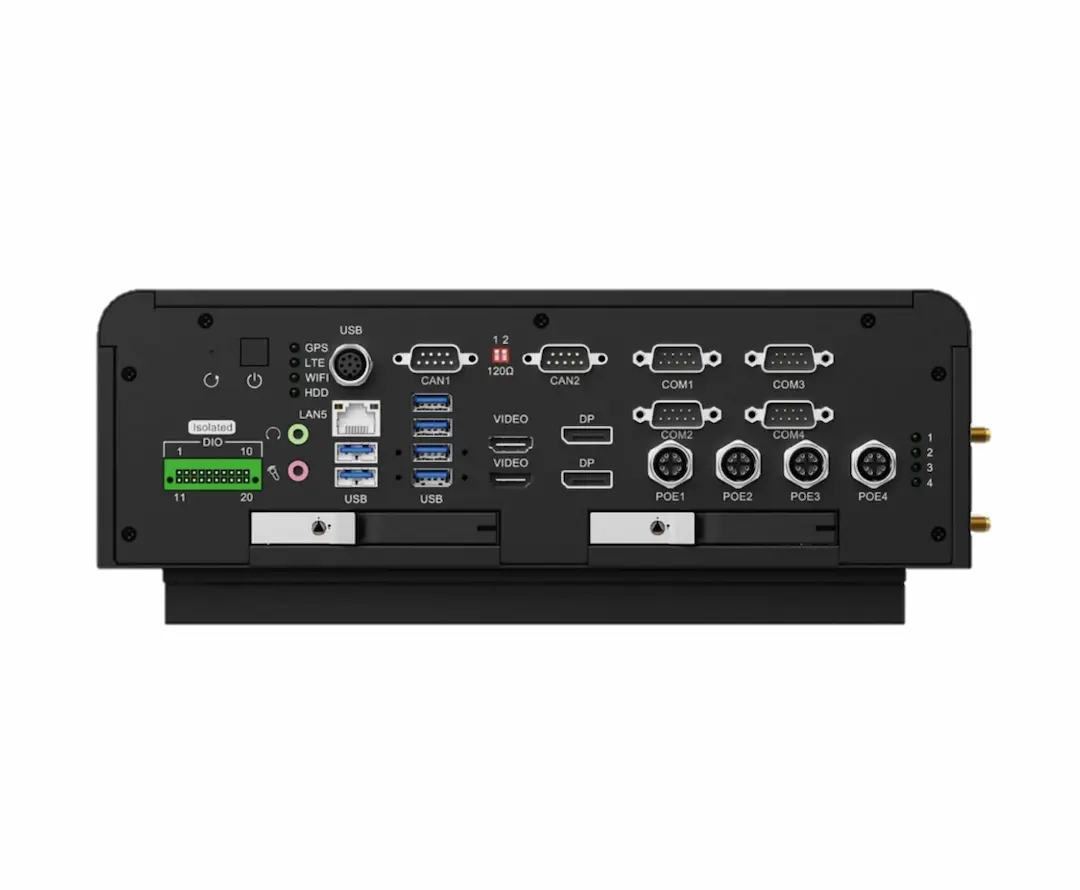
Vehicle AI PC platforms are designed specifically for these conditions. They combine computing performance with vehicle-oriented interfaces such as CAN communication, industrial networking, and expansion capabilities.
Vantron’s VPC-R5745 expandable in-vehicle AI Box PC represents this embedded approach, providing computing capabilities for intelligent transportation and vehicle applications. The platform is designed around Intel Core processors and includes vehicle-related interfaces, expansion options, and wide-voltage input support for mobile deployments.
Applications such as autonomous vehicles, fleet management systems, agricultural machinery, and special-purpose vehicles benefit from this type of architecture because computing resources are located where decisions need to be made.
Selecting the Computing Approach That Matches Equipment Goals
Choosing between industrial PC workstations and embedded computers requires evaluating the complete system environment.
Workstation-based systems are generally suitable when high processing power, user interaction, and flexible desktop-style operation are priorities. They fit applications where equipment remains stationary and computing resources can be installed separately.
Embedded computers are better suited for intelligent equipment that requires integrated operation, compact installation, and continuous field deployment. They are especially valuable for machines that combine sensors, AI algorithms, and real-time communication.
For equipment manufacturers, the decision also affects product development strategy. Embedded platforms can simplify machine integration and support scalable product designs, while workstations may provide greater flexibility for specialized computing tasks.
Vantron focuses on embedded and edge computing solutions that help manufacturers develop intelligent equipment across industrial, transportation, and automation sectors. Their product portfolio includes embedded computers, AI Box PCs, and application-focused computing platforms designed for different deployment environments.
The comparison between industrial PC workstations and embedded computers is ultimately not about identifying a universally superior option. Each approach solves a different engineering problem. The most effective choice is the one that aligns computing capability with the equipment’s physical environment, operational workflow, and long-term design objectives.
