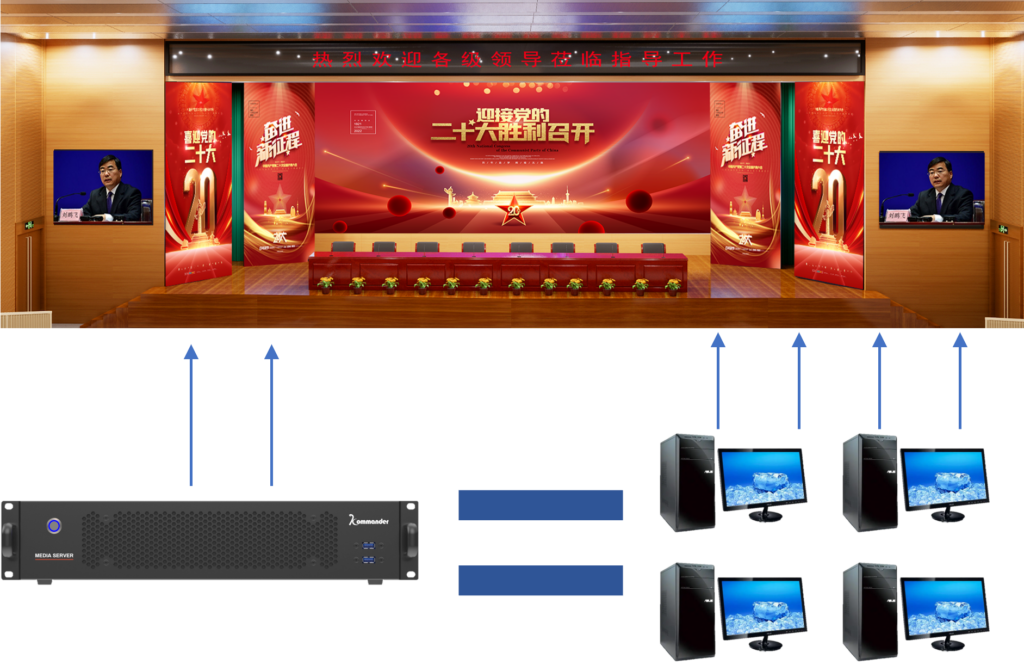
Three separate devices can divide a signal chain neatly: a switcher chooses sources, a video-wall processor creates the canvas, and an LED controller transmits it to receiving cards. One platform can also perform those jobs together.
The better architecture depends on ownership, scale, service boundaries, and recovery—not on the assumption that fewer boxes or more boxes are automatically superior. An integrated splicing processor reduces handoffs inside the chain. A separate design preserves independent stages. Each advantage becomes useful only when it matches the people, interfaces, and redundancy plan of the venue.
Compare the Number of Signal Boundaries
Every boundary adds cables, format negotiation, timing behavior, and a point at which responsibility changes. In a separate chain, HDMI or DisplayPort may leave the switcher, enter the splicer, then pass to an LED controller.
An integrated splicing processor can keep switching, composition, and sending inside one modular platform, reducing external conversions and the need to coordinate settings across several interfaces. Integration does not eliminate configuration. Source formats, canvas regions, port loads, and downstream receiving-card maps still require documentation.
It simply moves more of those relationships under one control structure. Fewer external links can reduce EDID handshakes and cable diagnostics, yet they also place greater importance on the platform’s internal status reporting. A unified interface is valuable only if it exposes the state of acquisition, composition, and LED output separately enough for technicians to isolate a fault.
Commissioning time also depends on configuration reuse. One project file can simplify scene recall, but exports, backups, version labels, and rollback procedures are needed so a later change does not overwrite the last approved operating state.
Weigh Modularity against Unified Operation
Separate devices can be replaced or upgraded independently. A venue with a standardized routing system may prefer to retain its switcher while changing only the display processor. Different teams may also own broadcast routing and LED control. An integrated splicing processor favors unified scenes, shared monitoring, and centralized recovery when one operating team owns the complete wall.
The decision should identify who diagnoses a black screen, who recalls a layout, and which spare hardware restores service. A modular chassis can still be integrated at the system level, while several standalone appliances can still be controlled centrally; the physical architecture and the operating model are related but not identical.
Lifecycle timing can change the preference. Separate stages allow one function to be renewed without disturbing the others, provided replacement interfaces remain compatible. A unified platform reduces cross-vendor coordination but may require a broader test whenever firmware, cards, or control software change.
Measure Capacity through the Complete Workflow
Source count, layer count, canvas pixels, and output type remain independent constraints. The integrated splicing processor must accept the busiest input set, compose the maximum simultaneous windows, and drive the intended LED load without treating one capacity figure as proof of the others. A separate chain requires the same calculation at each stage, plus verification that the handoff format fits the next device.
Kystar’s SHn Series uses a modular pure-hardware FPGA design and combines video processing, signal switching, video-wall splicing, and LED control. It supports end-to-end 8K workflows, RGB 4:4:4, DP1.4 input up to 8K@30Hz, and, on the largest configuration, up to 40 4K@60Hz input channels, 224 Ethernet ports, and approximately 147.2 million pixels.
Examine Control, Preview, and Recovery
Operators need to see signal state before changing the public canvas. Browser control, real-time preview, hardware monitoring, EDID management, Genlock, backup mechanisms, and more than 2,000 scene presets give an integrated splicing processor a common operational surface.
In a separate architecture, equivalent capabilities may exist across several interfaces and must be coordinated by procedure or an external control system. The SHn platform from Kystar also supports flexible windowing and layer sharing.
Kapollo can extend centralized control beyond the wall to audio, lighting, power, projection screens, motors, and other programmable equipment. That broader integration matters when the display participates in a venue-wide sequence rather than operating as an isolated endpoint.
Select the Failure Behavior, Not Just the Diagram
A comparison should include a source loss, output interruption, controller restart, and preset recovery. Separate devices can isolate certain failures and permit individual replacement, but they also create more cables, conversions, power supplies, and configuration files.
An integrated platform reduces some boundaries while concentrating more functions in one chassis. The better architecture is the one whose spare strategy, bypass path, and recovery time fit the consequences of the actual venue failure. Recovery drills reveal whether that theoretical boundary works under operating pressure.
The same exercise should record recovery time and the actions required from the operator. Automatic return is not always desirable if it places an unverified source on air; some venues prefer a controlled fallback scene until the original path has been checked.
The integrated splicing processor concentrates functions, so its internal backup and monitoring design deserves close attention. Separate devices distribute functions, but they can create more handoff failures and more states that must be restored in the correct order.
The stronger choice is the architecture whose failure behavior the project can test, document, and support. Unified processing is compelling when complex scenes and direct LED control belong under one operational authority. Separate stages remain sensible when existing infrastructure, independent ownership, or staged replacement carries more value than consolidation.
