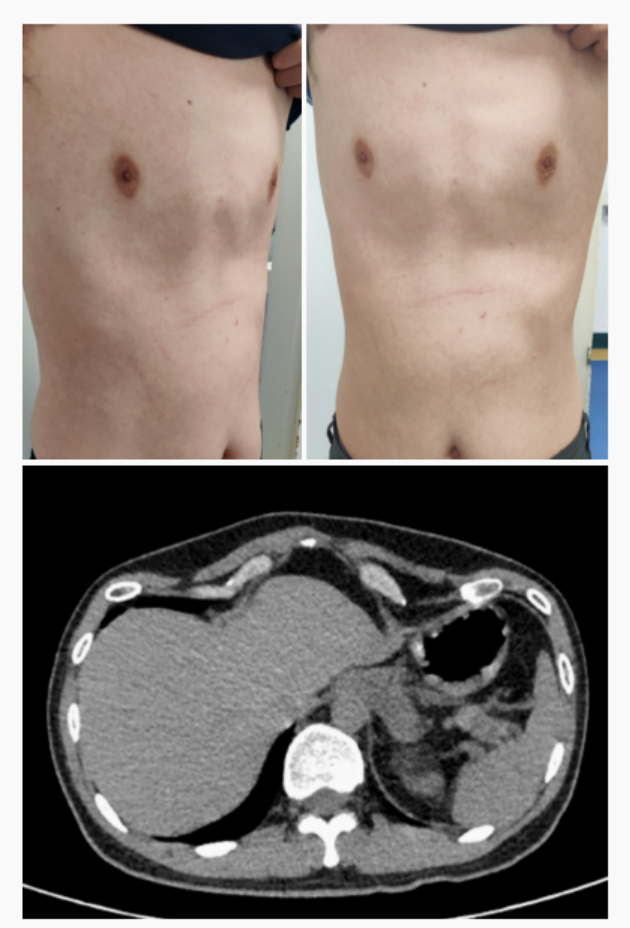
Saddle chest is a unique chest wall deformity characterized by symmetrical indentations on each side of the lower chest. These indentations are not connected and are separated by the normal height of the chest wall in the center, creating the appearance of a “saddle”. This condition, first named by Dr Wenlin Wang, is distinct from other chest deformities, requiring a thorough understanding for proper diagnosis and treatment.
Primary Saddle Chest: Understanding Its Origins
The causes of primary saddle chest remain unclear, but its occurrence may be related to calcium deficiency. Calcium deficiency causes softening of the bony structure, which, under the pull of the diaphragm, can lead to localized depressions in the lower chest wall. Also, various theories suggest that, in addition to calcium deficiency during fetal development, it may also be related to chronic breathing difficulties or asthma.
Post-Surgery Saddle Chest: The Secondary Cause
Secondary saddle chest can develop after the Nuss procedure, a surgery typically used to treat pectus excavatum (a condition of an indented chest wall). While the Nuss procedure is highly effective for pectus excavatum, one potential complication is the formation of a saddle chest. The fundamental reason Nuss procedure leads to secondary saddle chest lies in its surgical principle. The Nuss procedure requires using steel bars to elevate the central depression, and the bars need appropriate support points. When the depression is excessively severe—meaning the bar bears excessive force—this force concentrates on the local ribs. If the ribs are sufficiently rigid, it typically won’t cause localized abnormalities. However, if the ribs lack sufficient stiffness, it can lead to localized depressions, resulting in the characteristic saddle chest deformity with bilateral depressions and a normally contoured central region.
The Institute of Chest Wall Surgery (ICWS) specializes in the diagnosis and treatment of both primary and secondary saddle chest deformities, offering advanced surgical techniques, such as the Wang procedure and the Wung procedure, to correct the condition and improve the quality of life for affected individuals.
Conclusion
Understanding the causes and implications of saddle chest is essential for accurate diagnosis and treatment. Although the primary cause remains uncertain, factors like calcium deficiency suggest developmental origins for this condition. In contrast, secondary saddle chest often arises after the Nuss procedure, underscoring the importance of careful post-operative monitoring. For individuals affected by saddle chest, The Institute of Chest Wall Surgery (ICWS) provides cutting-edge surgical options, focusing on both restoring the chest wall appearance and alleviating the physiological discomfort and psychological stress caused by the deformity.
