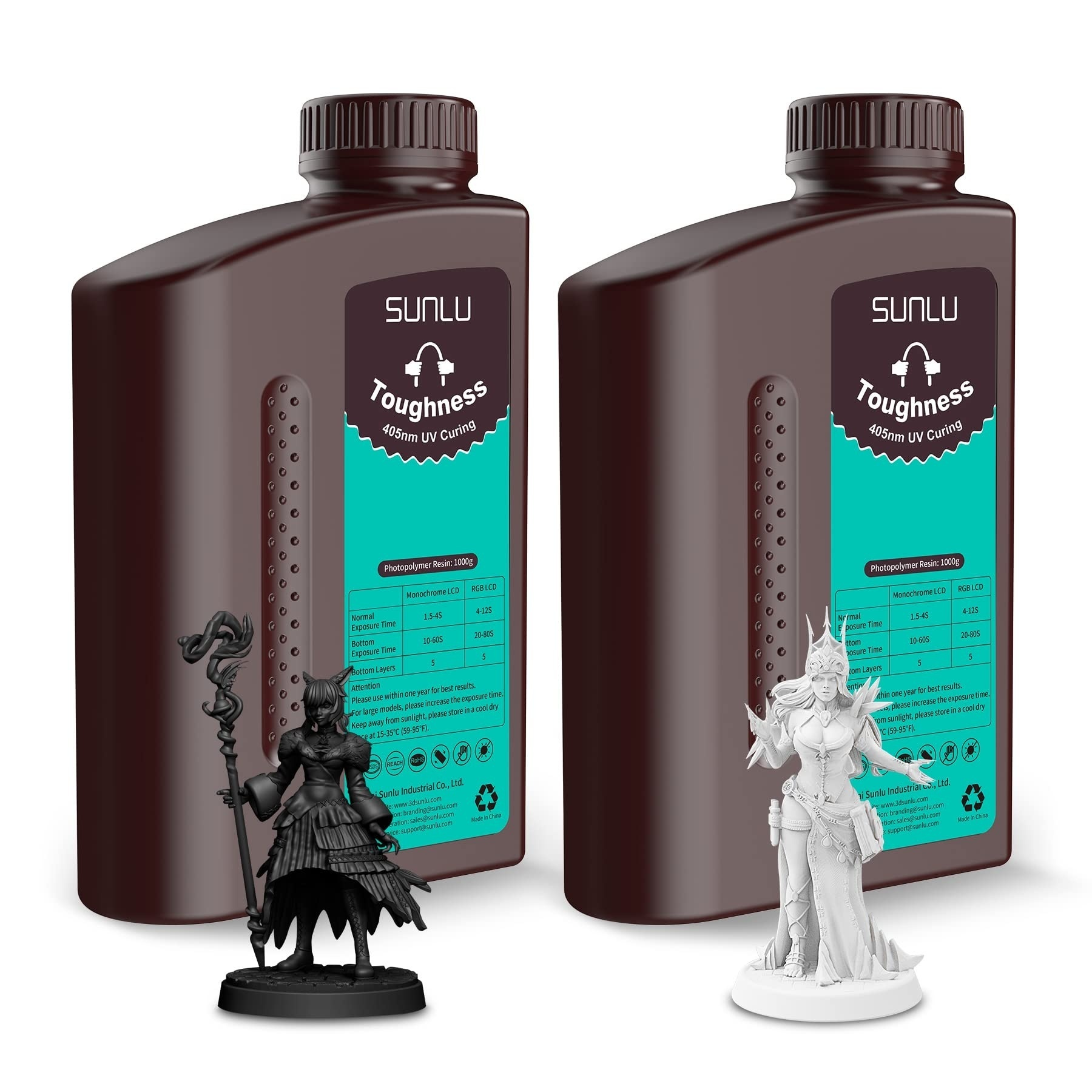
Choosing a 3d print resin depends on how the finished part will be used. ABS-Like Resin offers a balance of strength, rigidity, and toughness for detailed functional models, while Toughness Resin emphasizes elongation and impact resistance. Neither material suits every project. Comparing their mechanical properties, intended applications, and post-processing requirements can help you select a formulation that matches the demands of your design.
How Do ABS-Like Resin and Toughness Resin Differ?
Both are UV-curable photopolymer resins used with compatible resin 3D printers, but their mechanical characteristics differ. ABS-Like Resin has higher listed tensile and flexural strength, making it a candidate for rigid components and functional prototypes. Toughness Resin has higher elongation at break and impact strength, which can be useful when a part experiences bending or sudden force.
The main distinction is the balance between stiffness and deformation. A rigid enclosure may benefit from the strength profile of ABS-Like Resin, whereas a clip that flexes during assembly may call for a tougher formulation. Resin selection should account for the finished part’s geometry and loading, rather than the material name alone.
How Do Their Mechanical Properties Compare?
The manufacturer’s comparison chart provides the following figures for evaluating the two formulations.
| Property | ABS-Like Resin | Toughness Resin |
| Tensile strength | 28MPa | 20MPa |
| Flexural strength | 36MPa | 20MPa |
| Elongation at break | 25% | 50% |
| Notched Izod impact strength | 60J/m | 120 J/m |
| Heat deflection temperature | 50°C | 45°C |
| Shore hardness | 80D | 72D |
These specifications describe different aspects of performance. Tensile strength measures resistance to pulling, while flexural strength relates to bending. Elongation at break indicates how far a sample stretches before fracture in the specified test, and impact strength measures its response to a sudden force.
The figures suggest that ABS-Like Resin has greater listed tensile and flexural strength, while Toughness Resin offers higher elongation and impact strength. The comparison chart is used consistently here; individual product listings may report different figures for some properties. Check the current specifications for the exact resin before making decisions for critical components.
When Should You Choose ABS-Like Resin?
ABS-Like Resin is worth considering for functional prototypes, small housings, detailed model components, and parts that need to retain their shape during ordinary handling. Its higher listed tensile and flexural strength can be helpful when rigidity is a priority, while its impact characteristics provide a degree of toughness.
For example, a product-development team may print an enclosure to assess assembly clearances, component placement, or external dimensions. A detailed display model may also benefit from a formulation designed to reproduce fine features. The suitability of the resin still depends on wall thickness, support layout, exposure settings, and post-curing.
The key is to match the material to the prototype’s purpose. A model used to check dimensions has different demands from a clip that bends repeatedly or a component exposed to frequent impacts.
When Is Toughness Resin More Suitable?
Toughness Resin is designed for parts where greater deformation and impact absorption are useful. Potential applications include snap-fit concepts, clips, flexible hinges, shock-resistant housings, and functional prototypes that may experience repeated handling. Its higher listed elongation and impact strength make it a candidate for these applications.
However, greater toughness does not mean greater strength in every measurement. The comparison chart lists lower tensile and flexural strength for Toughness Resin than for ABS-Like Resin. A thin connector may tolerate bending differently from a rigid bracket, even when both are printed with the same formulation.
For parts that flex repeatedly or carry mechanical loads, test the printed design under representative conditions. Evaluate the actual geometry and assembly method alongside the resin specifications.
What Printing and Post-Processing Factors Matter?
Both formulations require exposure settings suited to the printer, resin color, layer height, and light source. Start with the manufacturer’s recommendations and use a calibration print when changing materials. Incorrect exposure can affect detail, support attachment, and the consistency of finished parts.
Model orientation and support placement also influence print quality. Supports need to hold the part during printing while limiting marks on visible surfaces. After printing, wash the model using a compatible cleaning method, allow it to dry, and complete UV post-curing according to the resin instructions. Handling uncured resin requires suitable protective equipment and a well-ventilated workspace.
A repeatable process makes comparison more useful: keep printing and post-processing conditions consistent when testing the two formulations.
How Can You Make the Final Choice?
Start with the main demand of the part. For greater listed tensile and flexural strength, ABS-Like Resin is a reasonable candidate. For designs that benefit from higher elongation and impact strength, Toughness Resin deserves consideration. Also compare operating temperature, wall thickness, dimensional requirements, and how the finished component will be handled.
SUNLU provides product information for both formulations to support this initial assessment. Print a representative sample, record the settings, and evaluate the part under realistic conditions before using it in a demanding application. The more suitable resin is the one whose properties match the design’s requirements, rather than the one with the highest figure in a single category.
