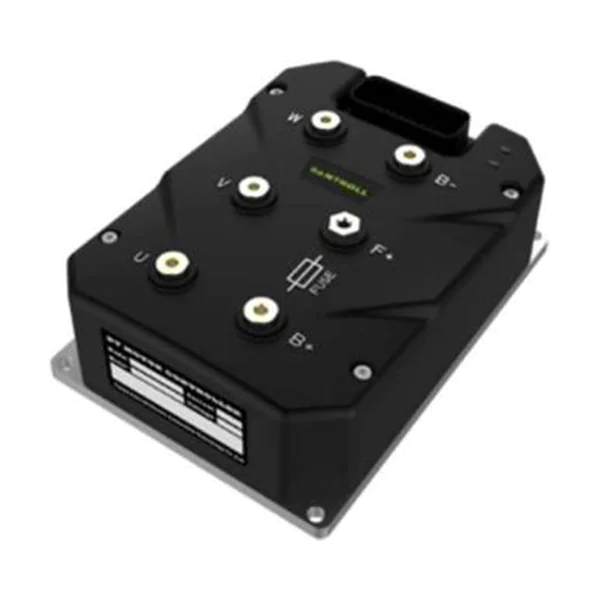
Current regulation serves as a fundamental operational mechanism within DC motor control systems, directly influencing torque output and system protection. This process involves a closed-loop control system where the motor controller continuously monitors and modulates the electrical current supplied to the motor windings. The principle is implemented through a combination of rapid switching and real-time feedback analysis. Santroll engineers its bldc motor controller systems around this precise regulatory function.
Pulse Width Modulation for Power Modulation
The primary tool for current regulation is Pulse Width Modulation (PWM). The motor controller switches the power supply to the motor on and off at a high frequency. The average voltage and current delivered to the motor are determined by the duty cycle—the ratio of on-time to the total switching period. To increase current and thus torque, the bldc motor controller extends the on-time; to decrease it, the on-time is reduced. This method provides efficient control over power delivery without dissipating significant energy as heat.
Real-Time Measurement and Corrective Adjustment
A critical component of this system is the current sensing mechanism. The motor controller utilizes sensors, such as shunt resistors, to provide instantaneous feedback on the actual current flowing in the motor circuit. This measured value is continuously compared to a predefined target current setpoint. Any discrepancy generates an error signal. The control logic within the bldc motor controller then automatically adjusts the PWM duty cycle to correct this error, ensuring the actual current closely follows the commanded value.
Torque Correlation and Operational Safeguarding
Because motor torque is directly proportional to current, this regulation provides direct command over mechanical output force. This allows for consistent torque production even under varying load conditions. Furthermore, this system incorporates vital protection. The motor controller can enforce a strict current limit, preventing the motor from drawing excessive current during startup, stalls, or overloads. This safeguard protects the motor windings, power transistors, and associated electronics from thermal damage.
The working principle of current regulation is therefore a dynamic, iterative process of measurement, computation, and adjustment. Santroll‘s implementation in its motor controller and bldc motor controller products prioritizes the responsiveness and accuracy of this control loop. This focused approach ensures that the motor delivers predictable mechanical performance while operating reliably within its designated electrical specifications.
