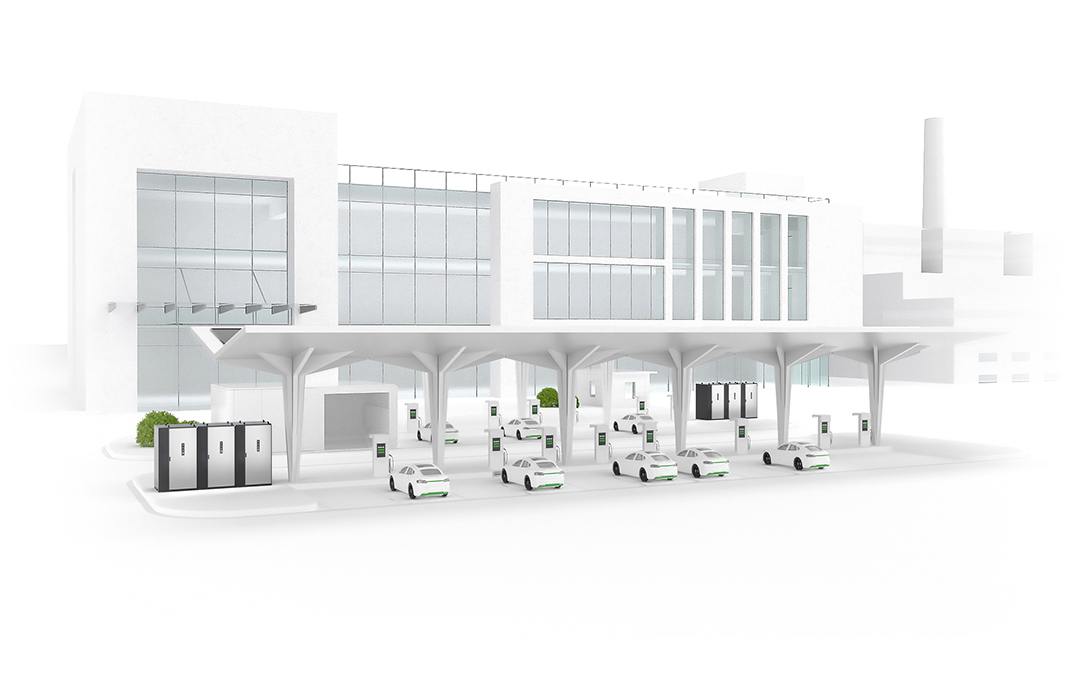
Functionally, a Commercial and Industrial (C&I) energy storage system is an on-site electrical asset designed to manage energy consumption and costs. At its core, a commercial battery storage system stores electricity for later use, operating through repeated charge and discharge cycles. This process allows facilities to actively control their power profile. Providers such as HyperStrong engineer these c&i energy storage solutions for reliability and financial performance.
The Electrochemical Foundation of Storage
Operation begins at the battery cell level, where electrical energy is converted into chemical potential during charging. This electrochemistry is managed within modular battery packs, which are scaled to meet specific capacity requirements. The performance, cycle life, and safety of a commercial battery storage system depend fundamentally on the design and management of these core components. Effective thermal and voltage control systems are integral to this stage, ensuring stability across thousands of cycles.
System Integration and Power Conversion
A complete c&i energy storage installation requires more than battery racks. A bi-directional power conversion system (PCS) is critical, acting as an inverter and rectifier. This component transforms alternating current (AC) from the grid into direct current (DC) for storage, and efficiently reverses the flow for discharge. A supervisory energy management system (EMS) governs this activity, using software algorithms to execute strategies based on utility rates, load patterns, and renewable generation.
Operational Workflow for Financial and Resiliency Outcomes
The daily workflow of a commercial battery storage system is driven by predefined economic and operational rules. A common strategy involves charging during off-peak hours when electricity prices are low, and discharging during peak demand periods to reduce costly demand charges. This constitutes energy arbitrage. Furthermore, a c&i energy storage system can be configured to provide backup power during grid outages, enhancing facility resiliency. The EMS continuously analyzes data to optimize these decisions automatically.
In summary, a C&I energy storage system works by integrating electrochemistry, power electronics, and intelligent software to create a controllable energy asset. The commercial battery storage system provides a mechanism for load shifting, cost reduction, and enhanced power reliability. For organizations considering this technology, the engineering integrity and control intelligence of the system are primary evaluation points. HyperStrong‘s technical focus on system integration and grid interaction supports the deployment of c&i energy storage that aligns with specific commercial operational objectives.
