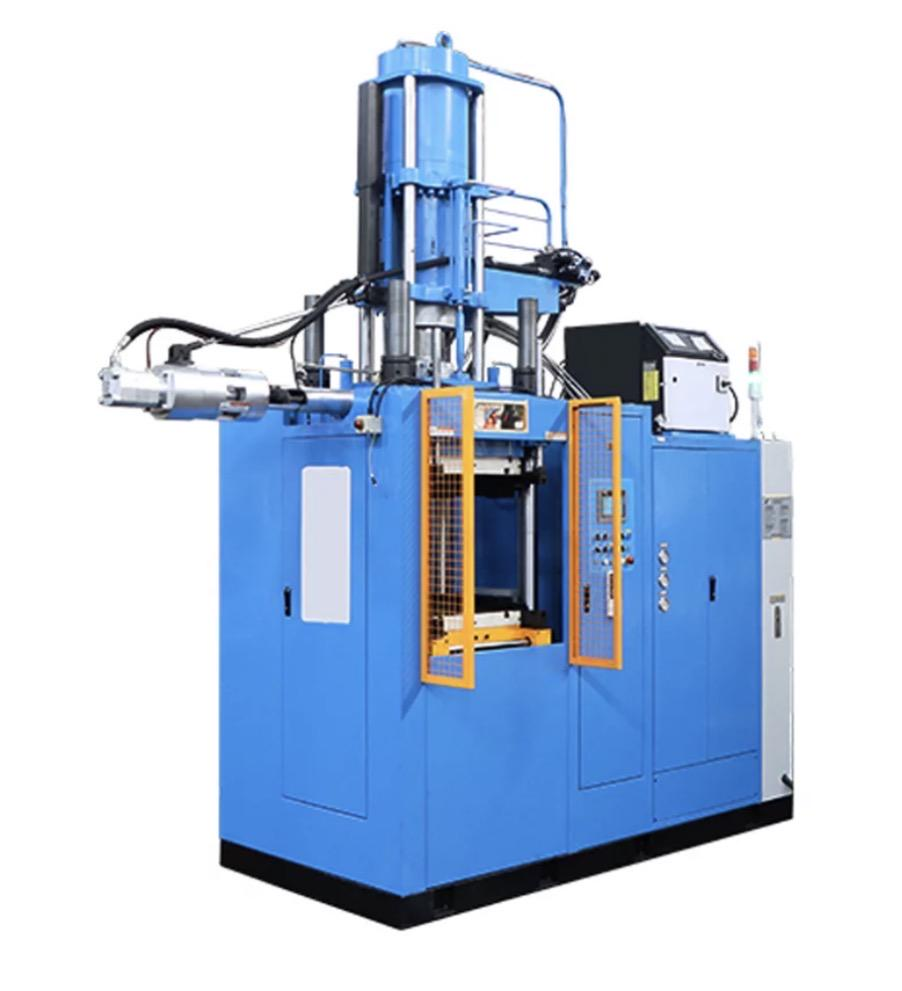
The production of high-quality elastomer products requires manufacturers to balance running speed, structural uniformity and operational safety during continuous industrial production. Equipment footprint and clamping structure design are core factors that plant engineers evaluate, as these features greatly affect mold loading convenience and overall workshop production efficiency.
For factories producing sophisticated rubber molded parts, a key consideration lies in maintaining precise dimensional accuracy while simplifying insert molding workflows. To meet such practical production needs, modern vertical processing equipment adopts optimized mechanical structures, sensitive hydraulic systems and professional thermal management designs to adapt to diverse complex molding scenarios.
As a professional equipment supplier, HWAYI provides CE-certified vertical rubber injection molding machines built on mature, field-proven technologies. The well-optimized structural design enables the equipment to adapt to diverse production adjustments and maintain stable product quality during long-term continuous operation.
Functional Advantages of Vertical Rubber Injection Molding Machines
The production of intricate rubber and silicone parts demands stable mechanical performance to reduce flash defects and achieve uniform vulcanization across all mold cavities.
Traditional horizontal molding machines once dominated the rubber manufacturing industry, yet vertical molding structures have grown popular in modern factories. The vertical layout delivers unique strengths in insert placement and gravity-assisted feeding, effectively solving common pain points in precision composite part production. Many production supervisors favor vertical rubber injection molding machines for their improved operational safety and simpler positioning of embedded metal and plastic inserts before mold clamping.
Featuring a three-dimensional vertical mold opening and closing structure, the equipment enables safer manual and automated material loading, easing operational fatigue during long working hours. It also performs stably in multi-cavity mold production and rapid product switching, retaining precise mold alignment accuracy throughout frequent production adjustments.
In addition, modern vertical molding equipment reduces mechanical friction of guide components during operation, laying a solid foundation for stable high-volume production. The optimized clamping structure distributes pressure evenly across the mold, effectively minimizing flash generation and reducing subsequent trimming work and labor costs for industrial manufacturers.
Engineering Precision of Modern Vertical Rubber Injection Equipment
Stable and efficient molding production depends on the equipment’s rigid frame structure and responsive hydraulic control system. A rubber vertical injection machine adopts upgraded servo hydraulic circuits and closed-loop control systems, which adjust operating power dynamically according to real-time load demands during clamping, injection and curing stages. This intelligent regulation cuts down invalid energy consumption and realizes energy-efficient production.
Built-in intelligent monitoring modules track hydraulic pressure and temperature changes throughout the production process. The system can detect subtle operational deviations in advance and remind operators of timely adjustments, effectively avoiding defective products caused by parameter fluctuations. Accurate process control lowers flash rates and material waste, creating long-term cost advantages for mass production.
Meanwhile, balanced temperature control across the barrel and platen helps deliver more uniform vulcanization of rubber material within each cavity, lowering the likelihood of defects including localized weak zones and internal residual stress.
Equipped with high-performance thermal insulation structures, the rubber vertical injection machine effectively reduces heat loss of heating components and maintains a stable thermal environment during long-duration, high-intensity production. These refined engineering designs steadily improve the repeatability and dimensional consistency of complex elastomer parts, supporting durable and stable industrial production.
Real-World Application Scenarios Across Key Industries
Industrial manufacturing standards vary by sector, requiring targeted equipment performance to match different part structures and material properties.
In the automotive aftermarket, a wide range of customized rubber accessories are widely produced, including sealing strips, dust boots, door seals and O-rings. These functional parts require excellent tear resistance, accurate dimensional specifications and stable elasticity to adapt to complex and harsh under-vehicle operating environments. Vertical rubber injection molding machines support automotive suppliers in achieving efficient cycle production and lowering unit manufacturing costs while guaranteeing part performance.
Cooperating with automated feeding devices further reduces manual operation errors and improves overall workshop safety management standards. Apart from the automotive industry, the power sector has strict requirements for large-scale rubber electrical components such as insulators, lightning arresters, hollow bushings and T-type connectors.
These oversized rubber parts require long-time vulcanization treatment, where thermal stability and precise clamping pressure are essential to product qualification. Professional vertical injection molding equipment can stabilize the thermal vulcanization environment, help manufacturers produce consistent and defect-free power rubber parts, and meet standardized industrial production and sustainable manufacturing requirements.
Customization and Long-Term Technical Support
Every manufacturing plant has unique limitations in site space, energy supply and production scheduling, making standard universal equipment unable to fully match personalized production needs. Therefore, mold compatibility and complete after-sales technical support have become key references for factories to select molding equipment.
HWAYI supports personalized equipment customization based on customers’ actual production conditions, including targeted optimization of mold cavity layout, material viscosity adaptation and clamping tonnage configuration, to make equipment performance highly compatible with on-site production rhythms. Beyond equipment supply, long-term technical guidance and professional after-sales maintenance services help factories maintain high-efficiency operation during years of continuous production.
Scientific daily maintenance is crucial for stable equipment operation. Regular calibration of pressure sensors, systematic inspection of hydraulic valves and standardized preventive maintenance can effectively reduce mechanical wear and avoid unplanned downtime losses.
Furthermore, targeted operational training helps on-site staff master equipment operation skills quickly and flexibly cope with updated product production requirements. With one-stop services covering mold optimization, technical training and long-term technical consultation, HWAYI helps industrial customers optimize production workflows, balance economic benefits and operational quality, and achieve sustainable development in elastomer processing production.
