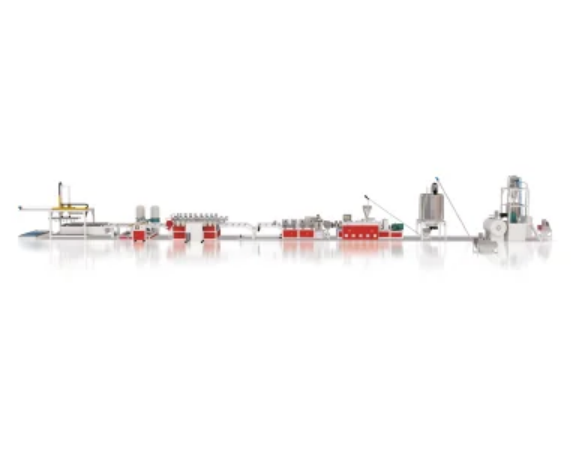
In the precision manufacturing of cellular plastic sheets, achieving a uniform gauge across the entire width of the board is a primary challenge. Thickness irregularities in a PVC foam board production line not only compromise the structural integrity of the final product but also lead to significant material waste and downstream processing issues. For B2B manufacturers producing boards for the construction or signage industries, maintaining a tolerance of ±0.2mm is often the benchmark for premium quality.
The Mechanics of Gauge Variation
Thickness inconsistencies are typically rooted in the fluid dynamics of the PVC melt as it exits the T-die. If the melt temperature is non-uniform across the die lip, the viscosity of the PVC will vary; lower viscosity sections will flow faster, leading to “thick spots.” Conversely, if the die gap is improperly calibrated or if the internal pressure of the blowing agent fluctuates, the expansion rate of the foam will be uneven.
Furthermore, the “haul-off” or traction unit plays a critical role. If the pulling speed is not perfectly synchronized with the extrusion speed of the PVC foam board extrusion line, the board can stretch or compress, causing longitudinal thickness waves. Mechanical issues, such as a clogged vacuum vent in the degassing zone or a worn-out screw flight, can also cause “surging,” where the volume of material delivered to the die fluctuates periodically, resulting in a repetitive pattern of thin and thick sections.
Precision Engineering Solutions by Boyu
To mitigate these operational risks, equipment must be designed with high-sensitivity feedback loops. Boyu engineers their PVC foam board production line with advanced T-die technology featuring adjustable “restrictor bars” and heated die lips that allow for micro-adjustments in melt flow. Their systems, such as the SJSZ-92/188 series, utilize high-torque gearboxes and Siemens PLC control systems to maintain a constant, surge-free output of material.
Their PVC foam board extrusion line is built for the rigorous demands of 24/7 industrial production, incorporating high-precision Omron temperature controllers. By utilizing synchronized AC frequency conversion for the traction and cutting units, they ensure that the board is pulled at a perfectly constant rate, eliminating mechanical stretching. For B2B clients, their commitment to these technical specifications means fewer rejects and a more reliable ROI. Through these robust engineering standards, they provide their partners with the tools necessary to produce world-class PVC foam boards with impeccable dimensional accuracy.
